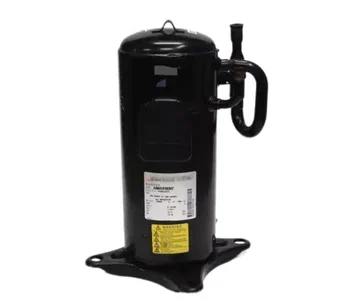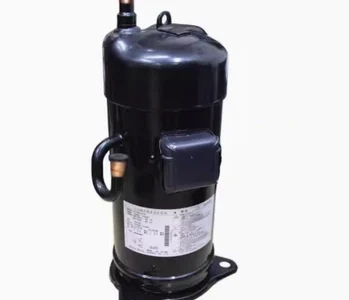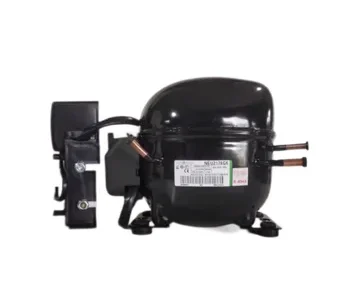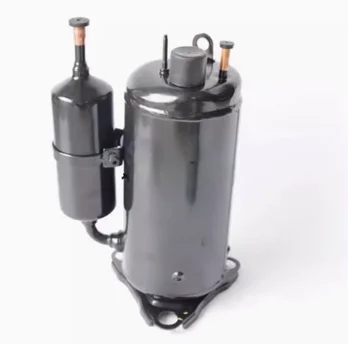
The DA422A3F-27M is an inverter compressor for central air conditioning – VRF/VRV outdoor units, ducted central systems, and multi-zone commercial applications – available factory-direct from $458. Central systems run for a decade or more across thousands of operating hours, so compressor selection drives lifetime energy cost, comfort quality, and service economics. This guide covers the technology, specifications, system architecture considerations, selection methodology, and buying guidance for consultants, OEM engineers, and facility maintenance teams.

Quick Answer: Where Does the DA422A3F-27M Fit?
Between the small-split segment and the heavy commercial rack class. It is built for central/multi-zone systems where one outdoor unit serves multiple indoor zones – the architecture behind VRF/VRV, ducted residential-central, and light commercial rooftops. As an inverter compressor, it modulates capacity continuously; as a central-system component, it pairs with the system’s drive and control platform.
Specifications
| Parameter | Specification |
|---|---|
| Model | DA422A3F-27M |
| Type | Inverter (variable frequency) compressor |
| Target application | Central air conditioning, VRF/VRV, ducted systems |
| Drive requirement | Matching inverter drive per datasheet |
| Minimum order quantity | 1 piece |
| Price | from $458 (contact for quotation) |
Why Central Air Systems Demand Inverter Compressors
Central systems differ from room splits in one decisive way: load diversity. A central unit serves zones with independent, staggered demand – offices occupied at different hours, rooms with different solar exposure, meeting spaces used intermittently. The aggregate load therefore swings across a wide range all day, and rarely sits at the design maximum.
A fixed-speed central compressor handles that swing by cycling: on at 100%, off at 0%, hammering the electrical supply with inrush current at every start while temperature control coarsens. An inverter compressor like the DA422A3F-27M tracks the aggregate load continuously:
- Part-load efficiency: central systems spend 70-90% of operating hours below 60% load – precisely where modulating operation beats cycling hardest. System energy savings of 30-40% are the norm.
- Tight zone control: modulation holds supply conditions steady, which the zone-level actuators translate into stable room temperatures (within roughly 0.5 C rather than 2 C).
- Soft starting: ramped starts eliminate locked-rotor inrush – protecting the compressor mechanically and the building electrically, and often reducing peak-demand charges.
- Wear reduction: starts are the dominant stress event in compressor life; removing them directly extends service life.
In VRF/VRV architectures specifically, inverter compressors are the enabling technology – capacity modulation is what allows one outdoor unit to serve many zones efficiently and independently.
Application Scenarios: Where the DA422A3F-27M Works
Scenario 1: VRF outdoor units in multi-zone office buildings
A four-story office building runs one VRF outdoor unit serving twenty indoor cassettes and ducted units – each zone occupied on its own schedule. At 8 AM the east offices load first; by afternoon the load has migrated west; meeting rooms spike on demand. The aggregate demand a fixed-speed system would chase with crude cycling is instead tracked continuously by modulation. This is the defining application of the DA422A3F-27M’s class, and the reason inverter compressors became the architecture of commercial comfort cooling: 30-40% energy savings measured against the same building on fixed-speed equipment.
Scenario 2: Ducted central systems for villas and large residences
A 250-400 m2 villa with a concealed-duct central system presents residential comfort’s hardest problem: radically different loads between a occupied kitchen at dinner time and sleeping quarters at 2 AM. Central fixed-speed equipment forces a choice between overheating one zone or undercooling another; an inverter-driven central unit ramps output to wherever the zone dampers send demand. The compressor’s soft-start ramping also protects the home’s electrical system – no light-dimming inrush every cycle.
Scenario 3: Light commercial rooftops
Restaurants, clinics, and retail units run rooftop packaged units through long trading hours against door-traffic infiltration and kitchen heat. Their load profile – high at opening, moderate through the day, spiking at peak trade – rewards modulation heavily, and their owners notice the electricity bill monthly. For service companies maintaining rooftop fleets, carrying a matching inverter compressor spare converts a multi-day contractor visit into a same-day repair.
Scenario 4: Multi-zone heat pump platforms
In moderate-climate markets, the same outdoor architecture heats in winter and cools in summer. Reverse-cycle duty doubles the compressor’s operating hours and widens its operating envelope – exactly the sustained, varying duty inverter modulation is built for (platform-level reverse-cycle support to be confirmed with engineering at quotation).
Selection Methodology for Engineers
A defensible selection at this level goes beyond nameplate matching:
- Load profile analysis: calculate the diversified load – simultaneous demand across zones – not the sum of zone peaks. Inverter systems size to diversified load with a modulation check at minimum and maximum.
- Modulation envelope fit: confirm the compressor’s operating envelope covers your minimum load point (turndown) without short-cycling, and your maximum with pull-down margin.
- Drive/platform compatibility: the DA422A3F-27M must pair with a matching inverter drive – frequency range, current rating, control method, protection settings per the datasheet (the same discipline as our small-split inverter guide covers in detail).
- Refrigerant confirmation: state the system refrigerant at quotation; A2L circuits (R32/R454B) require A2L-rated components.
- Electrical coordination: drive input harmonics, supply capacity, and protection coordination with the building system.
- Serviceability planning: access clearances, isolation provisions, and monitoring points for commissioning and maintenance.
Installation and Commissioning Essentials
- Nitrogen-purged brazing on all joints to prevent internal oxide contamination.
- Deep vacuum below 500 microns with a standing decay test – non-negotiable with inverter windings and POE oil.
- Charge by weight, verified against the system design charge; correct for line length per the system’s installation data.
- Drive parameter verification against the compressor datasheet before energization – frequency limits, current limits, protection thresholds.
- Insulation test the motor windings before start-up and log the values as a baseline.
- Commission with full data capture: pressures, superheat/subcooling, amps across the modulation range, and vibration signature – this becomes the reference for all future service.
Maintenance Notes for Inverter Central Systems
Inverter compressors reward disciplined maintenance differently from fixed-speed units: because they run continuously rather than cycling, monitoring trends (amps at given frequencies, discharge temperature, oil return behavior) yields earlier warning than failure statistics alone. Keep condenser coils clean, protect drive electronics from heat and dust, and treat any drive fault code as a compressor-health data point, not just an electrical nuisance.
Price, Ordering, and Support
Factory-direct pricing starts at $458 with one-piece MOQ – sample validation before production commitment is straightforward. OEM and volume pricing steps down from there; request a quotation with annual quantity and platform details. Air freight serves urgent replacements; sea consolidation suits production schedules. Export packaging and documentation are standard worldwide.
View the DA422A3F-27M product page for a quotation, or submit requirements through the inquiry form. The technical documents page carries datasheets and commissioning documentation.
Pros and Cons
| Pros | Cons |
|---|---|
| Efficient modulation matched to central-system load diversity | Requires matching inverter drive and platform integration |
| Enables VRF/VRV architectures and tight zone control | Higher complexity than fixed-speed replacements |
| Factory-direct pricing from $458 | Configuration-specific – engineering confirmation before ordering is essential |
| Soft starting reduces electrical and mechanical stress | Drive electronics add a maintenance dimension |
Frequently Asked Questions
Can the DA422A3F-27M replace a fixed-speed central compressor?
Not directly – it requires a matching inverter drive and compatible system controls. Retrofitting inverter operation onto a fixed-speed platform is a system redesign, not a compressor swap.
What refrigerant does it use?
Confirm at quotation stage; specify your system’s refrigerant. A2L refrigerants require A2L-rated components.
Is it suitable for residential use?
It targets central/multi-zone systems – which include large residential ducted systems, though not single room splits (see the smaller SNB130FGYMC-L1 for that segment).
How does it affect electricity bills?
Typical measured savings versus equivalent fixed-speed central systems run 30-40% at real-world part-load profiles.
What is the minimum order?
One piece – suitable for both validation samples and production volumes.
Do you support OEM customization?
Yes, discuss platform requirements with the engineering team; datasheets and drive-matching documentation are provided.
Conclusion
Central air systems live or die on how well their compressor tracks a diversified, ever-moving load. The DA422A3F-27M brings genuine inverter modulation to that duty at a factory-direct $458 entry point, with the architecture compatibility to serve VRF, ducted, and light-commercial platforms. Select it with the engineering discipline above and it will repay a decade of operating hours in energy and comfort. Explore the full catalog or the solutions pages for adjacent options.